I’m sure everyone has heard of the devastating event with Damar Hamlin at the Buffalo Bills vs Bengals game last night. Damar took what appeared to be a not super hard shoulder to the chest during a play as probably happens a million times during a million football games but this time one was way more serious because he went into cardiac arrest almost immediately, collapsing on the field.
Because there are obviously trainers and medical personnel present, they identified cardiac arrest and began CPR almost immediately, also utilizing the AED and shocking him on the field. They were able to get a heart rhythm back and get him to the hospital for further treatment but he is presently in the ICU. The world is praying for a good outcome for this young, healthy athlete.
So what happened? The speculation regarding this event is that he suffered from something called Commotio Cordis (comm-OH-shee-oh COR-diss) which is a cardiac arrest after a blow to the left chest at the exact second the heart is entering the T-wave portion of the electrical impulse. The reasoning for assuming this diagnosis is that he took the shoulder to the chest and then almost immediately dropped on the field. He is a healthy, young man with no existing conditions, cardiac or otherwise, that would give concern for a cardiac event.
I will preface the further information by stating that I am NOT a cardiac nurse by any means so when I heard this was the probable diagnosis I had to start researching. I remember learning about this in nursing school and during my emergency trauma training but I didn’t remember the specifics. I remembered learning about this when I was a medical assistant in pediatrics and one of the doctors experienced a similar event while working as a medical consultant for a Little League baseball game when a young player took a pitch to the chest while not wearing a chest pad.
So what is Commotio Cordis? In a nutshell, a person receives blunt force trauma to the left chest during the exact moment that the T-wave is beginning causing an interruption in the cardiac repolarization of the ventricle thus scrambling the electrical impulse causing depolarization instead and causing the heart to go into ventricular fibrillation (v-fib) which is a non sustainable cardiac rhythm.
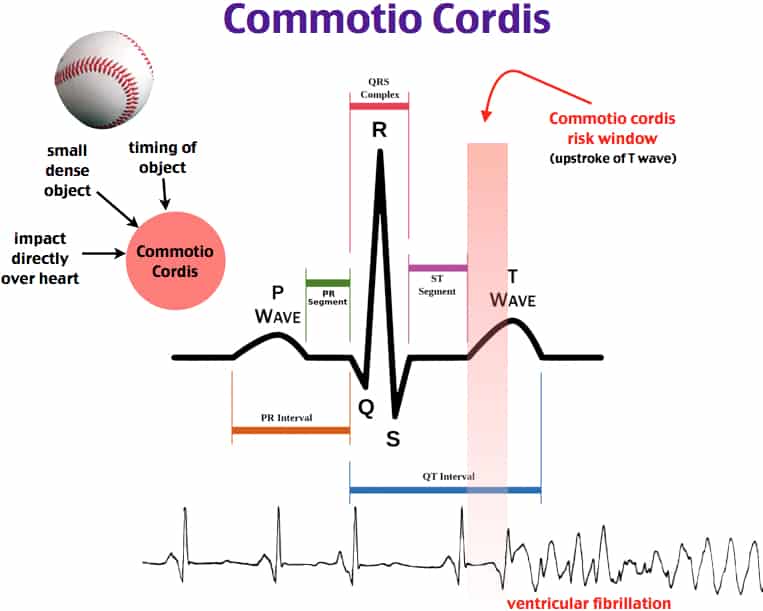
As we’ve all learned from nursing school and BLS/ACLS training, v-fib leads to cardiac arrest and v-fib is a shockable rhythm. This is why it is so incredibly important to have a working AED available, especially during any sports, PE class, or even recess where kids are playing and running around. It is equally as important for people (including students) to have BLS training because the sooner you start perfusion the better the outcome will be after cardiac arrest.
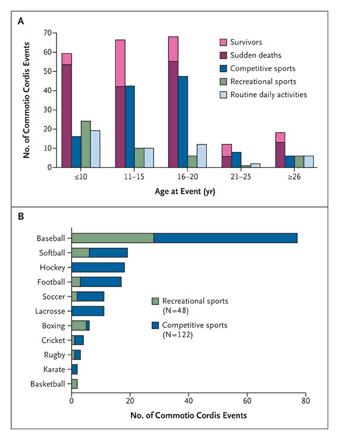
Commotio Cordis (CC) is most commonly associated with baseball/softball players as they run the risk of being hit directly in the chest with a fast moving ball. Additionally it is associated with hockey puck, lacrosse ball, soccer balls, cricket balls, and hockey sticks as they all have the likelihood of a fast moving direct hit to the chest. Also, any blow to the chest from a tackle, a punch (boxing, MMA fighting, martial arts), or even car accident can also cause CC.
Commotio Cordis treatment includes:
- Rapid recognition of cardiac arrest
- Immediately beginning CPR/chest compressions
- Call EMS
- Retrieve AED and defibrillate as soon as possible.
Can it be prevented? Yes, if proper safety precautions are taken then it can be prevented or treated quickly. Following these steps will help:
- Have an athletic trainer present at practices and games
- Educate coaches, parents, and athletes how to perform CPR and use an AED
- Educate coaches, parents, and athletes of signs of commotio cordis
- Have an AED accessible near playing fields at all times
- Ensure coaches know where to locate the AED
- Ensure there is an Emergency Action Plan in place
- Ensure protective equipment is properly fitted
- Teach athletes how to avoid being hit with a ball/puck
- Avoid strength disparities among participants and coaches
- Use safety baseballs
So why should a school nurse be worried about this? While it is fairly rare (less than 30 cases reported per year) it is always a possibility during any kind of physical activity that could cause trauma to the chest. Along with sports trainers and coaches, PE teachers, and anyone supervising physical activities and sports, we should be ensuring that people have CPR training and there are working AEDs accessible in the building. It is important that students are also educated in sudden cardiac arrest, CPR, and AED usage as there have been cases where it was the young student that saved another student or staff member’s life because of their fast thinking and knowledge of CPR.
As the school nurse be sure to consider what is the person wearing? Football pads? Baseball pads? How will you get through those to begin CPR? My suggestion for the fastest way is either trauma shears (keep them with the AED) or begin CPR with the pads on (make sure you’re giving GOOD compressions) and then cut off the clothes when the AED arrives.
Make sure there is a plan in place in the case of sudden cardiac arrest and that those present know their role and how to access the needed equipment and help. Ensure that AEDs are marked clearly and that everyone knows where they are, make sure there is someone who knows how to do CPR present. Every second counts, the longer everyone is debating what to do the longer the patient is without perfusion. Immediate CPR gives the better outcomes.
Here are some visual explanations of Commotio Cordis:
https://ksi.uconn.edu/emergency-conditions/cardiac-conditions/commotio-cordis/
https://www.ahajournals.org/doi/full/10.1161/circep.111.962712
https://www.ncbi.nlm.nih.gov/books/NBK526014/

 School Nurse Headquarters
Thank you for sharing such valuable information.
LikeLiked by 1 person